YouTube / iTunes / Spotify / Radio Public / Pocket Casts / Breaker / Overcast
Listen to ArtisanEnglish.jp posts & lesson intros here.
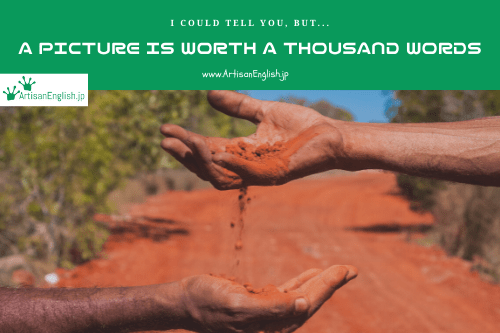
Phrase: A picture is worth a thousand words
A picture is worth a thousand words is a phrase with which you may already be familiar.
It means that complex ideas can be more easily conveyed with an image than by verbally explaining them.
Have you ever tried origami?
You can purchase books that describe with pictures and diagrams and in very few words how to fold the paper.
A picture is worth a thousand words means that complex ideas can be more easily conveyed with an image than by verbally explaining them.
Can you imagine instructing someone over a phone call on how to create an origami figure?
Teaching someone how to fold a paper crane during a phone call would require more than a thousand words; I promise you that.
Many years ago, when I was first starting my journey to become an English teacher, I took a six-week TESL course in Vancouver.
It was a fantastic program, but the institution has since gone out of business, so I won’t recommend it here.
For monolingual speakers, it isn’t easy to understand the challenges adult language learners face.
Sure, if you want to explain something, a picture is worth a thousand words, but a picture defeats the purpose of an English language lesson.
One activity the instructor had us undertake was to explain how to tie shoelaces verbally.
Believe me, it was an arduous task and a memory that has stayed with me.
So, for clarity and speed, a picture is worth a thousand words and makes it easy to communicate across a language barrier.
However, as I always like to say:
Vocabulary is like money.
The more money you have, the richer you are.
The more vocabulary you know, the richer your language will be.
That’s why English teachers and students create conversations, not pictures.
Flesch-Kincaid Readability Test
This post is understandable by someone with at least an 8th-grade education (age 13 – 14).
On the Flesch-Kincaid reading-ease test, this post scores 64.
The easier a passage is to read, the higher the score on a scale of 0 – 100.