YouTube / iTunes / Spotify / Radio Public / Pocket Casts / Google Podcasts / Breaker / Overcast
Listen to ArtisanEnglish.jp posts & lesson intros here.
WotD: Black humour
If English is not your first language, you understand that there is nothing more difficult to understand in a foreign language than humour.
Probably the most difficult kind of humour to find funny is black humour.
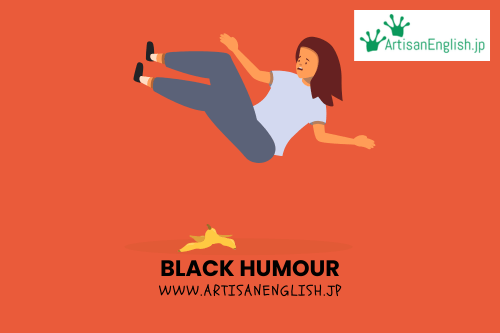
Black humour is a type of comedy that makes jokes about serious, sad, or even frightening topics such as death, illness.
The main idea of black humour is to find something funny in the darkest or most serious situations.
This kind of humour is not for everyone, not even all English speakers like or understand it, but many people enjoy it because it can make tough topics easier to discuss.
Black humour is a type of comedy that addresses serious or taboo topics in a light, playful way.
For example, making a joke about a scary visit to the dentist, even though many people are afraid of dentists, is black humour.
People use black humour to deal with stress, fear, or sadness.
You can find black humour in movies, books, and even in daily conversations.
Black humour can help people laugh about things that usually make them feel bad.
In some cultures, black humour is common, but in others, it might seem rude or odd.
Of course, British people are famous for black humour because they are pretty much born miserable.
If you use black humour, it is important to think about who is listening.
Not everyone will find jokes about serious topics funny, and some people might feel uncomfortable.
That’s OK.
They have a right to be offended, and you have a right to offend them.
We don’t live in America.
You can find black humour in popular TV shows, stand-up comedy, and even cartoons.
Writers and comedians use it to talk about things that are hard to discuss in a normal way.
Black humour can help people see things from a new point of view.
Remember, black humour is a special kind of comedy, so it should be used carefully and with respect for others’ feelings.
And I say this tongue in cheek.
Flesch-Kincaid Readability Test
This post is understandable by someone with at least a 7th-grade education (age 13).
On the Flesch-Kincaid reading-ease test, this post scores 75.
The easier a passage is to read, the higher the score on a scale of 0 – 100.