YouTube / iTunes / Spotify / Radio Public / Pocket Casts / Breaker / Overcast
Listen to ArtisanEnglish.jp posts & lesson intros here.
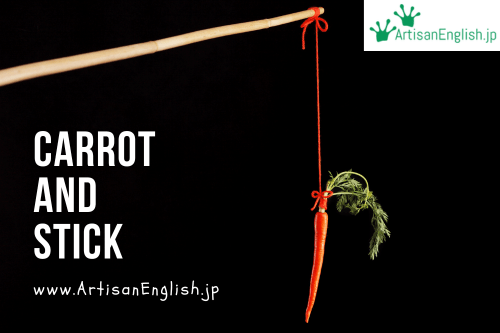
Idiom: Carrot and stick
Sometimes you give a carrot; other times, you have to use the stick.
Carrot and stick is a popular English idiom used to describe a motivational approach that combines rewards and punishments.
The “carrot” stands for a reward, such as praise, bonuses, or other positive outcomes.
The “stick” represents a punishment or negative consequence, like criticism or a warning.
Together, the carrot-and-stick approach encourages people to take desired actions by offering small rewards for desired actions or by discouraging mistakes with mild consequences.
Definition of Carrot and Stick
The carrot-and-stick method involves using both positive and negative incentives to influence behaviour.
For example, a manager might offer a bonus (the carrot) for meeting sales goals and a warning (the stick) for missing them.
This approach is common in workplaces, classrooms, and even in parenting.
Impact of the Carrot-and-Stick Approach on Intrinsic and Extrinsic Motivation
The carrot-and-stick approach exemplifies extrinsic motivation, using rewards or punishments to influence behaviour.
However, it can undermine intrinsic motivation by shifting focus from internal satisfaction to external incentives, potentially reducing genuine interest or internal drive over time.
Usage in Everyday Life
The carrot-and-stick method can be used in many situations.
For example, teachers might give students a gold star (a little win and the carrot) for finishing homework, but give extra work (the stick) if assignments are late.
In the workplace, managers can boost team motivation by rewarding little wins, such as meeting deadlines or improving quality.
This helps keep everyone focused and moving forward.
By understanding the carrot-and-stick method and the importance of different motivational approaches, anyone can improve motivation and achieve better results, whether at work, school, or home.
Flesch-Kincaid Readability Test
This post is understandable by someone with at least a 7th-grade education (age 12).
On the Flesch-Kincaid reading-ease test, this post scores 75.
The easier a passage is to read, the higher the score on a scale of 0 – 100.