YouTube / iTunes / Spotify / Radio Public / Pocket Casts / Google Podcasts / Breaker / Overcast
Listen to ArtisanEnglish.jp posts & lesson intros here.
Phrase: Damn with faint praise
I’m going to introduce the phrase damn with faint praise today, and I want you to understand there are no four-letter words here, even though we are using the word damn.
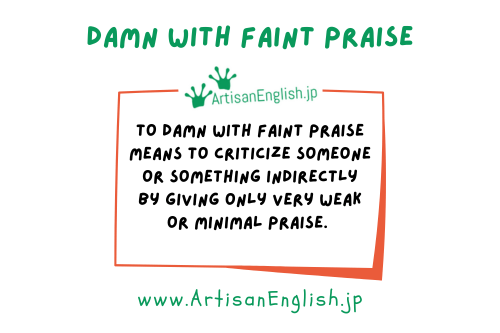
To damn with faint praise means to criticize someone or something indirectly by giving only very weak or minimal praise.
Instead of saying something clearly negative, a person uses a small, unenthusiastic compliment.
If, however, you read between the lines, it is very clear that they do not think highly of the subject.
For example, if someone says, “Your presentation was not as bad as I expected,” you’ve been damned with faint praise.
Here, you’re not receiving real praise; rather, it’s been suggested that your presentation wasn’t very good.
To damn with faint praise is a polite way to show criticism without being direct or rude.
People often damn with faint praise when they want to avoid hurting someone’s feelings or when they do not want to be openly negative.
If a teacher says, “You managed to finish your essay,” instead of saying it was good, you’ve been damned with faint praise.
Another example: “Your cooking is… edible,” also damns with faint praise.
Sometimes, people damn with faint praise because they are jealous or do not want someone else to feel too proud.
For instance, if your friend says, “You look better than usual today,” you’ve been damned with faint praise.
In summary, to damn with faint praise is to criticize by giving only weak compliments.
Learning to recognize when people damn with faint praise will help you understand hidden meanings in English conversations.
Congratulations!
You have read or listened to, or perhaps even both, to the end of this post!
Wow, aren’t you wonderful?
Flesch-Kincaid Readability Test
This post is understandable by someone with at least a 7th-grade education (age 12).
On the Flesch-Kincaid reading-ease test, this post scores 75.
The easier a passage is to read, the higher the score on a scale of 0 – 100.