(Photo: Pete Linforth/Pixabay | Text: David/ArtisanEnglish.jp)
YouTube / iTunes / Spotify / Radio Public / Pocket Casts / Breaker / Overcast
Listen to ArtisanEnglish.jp posts & lesson intros here.
WotD: Digital hoarding
Estimated reading time: 3 minutes
How much digital stuff do you have saved in the cloud?
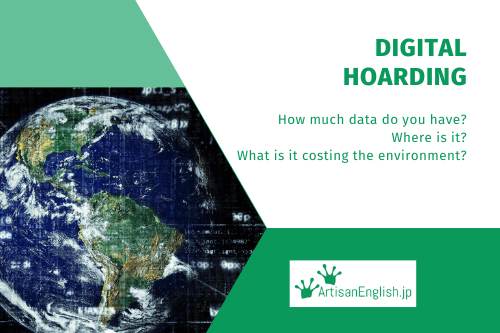
Digital hoarding is a growing nightmare for environmentalists and those who want to do right by the environment.
Whether you refer to it as e-hoarding, datahoarding, digital hoarding or cyberhoarding, it all amounts to the same thing – storing excessive amounts of data and the reluctance to delete anything.
If you want to learn more about this topic, I’ve created a lesson on it called Data Burn.
Ask me about it, or click the link to learn more.
Take a moment to check through your phone to see how many meaningless copies of photos you have.
How about your emails?
The email you have archived may have been useful at one time, but are they still relevant today?
If they aren’t helpful, why do you even have them stored away?
As time goes by, more and more people are becoming aware of the need to reduce the strain we place on the environment and our resources.
We worry about plastic packaging and what effects our fossil fuel-burning vehicles are doing to the planet.
Like or follow ArtisanEnglish.jp on social media.
However, we never think about digital hoarding.
All the data stored in the cloud is not just floating up in the sky somewhere.
‘The cloud’ is a digital storage facility or data center somewhere.
There are thousands of servers storing immense amounts of useless data that nobody accesses anymore and serves no useful purpose.
The main challenge is not that the data is stored but that the servers must be kept cool, requiring electricity that most likely comes from thermal power stations.
These power stations burn coal or gas to create electricity and, therefore, expel tons of carbon dioxide.
Digital hoarding is a growing concern.
Take a few minutes to go through your data to see what you can and should delete.
Flesch-Kincaid Readability Test
This post is understandable by someone with at least an 8th-grade education (age 13 – 14).
On the Flesch-Kincaid reading-ease test, this post scores 62.
The easier a passage is to read, the higher the score on a scale of 0 – 100.