YouTube / iTunes / Spotify / Radio Public / Pocket Casts / Breaker / Overcast
Listen to ArtisanEnglish.jp posts & lesson intros here.
WotD: Greener Pastures
Definition of Greener Pastures
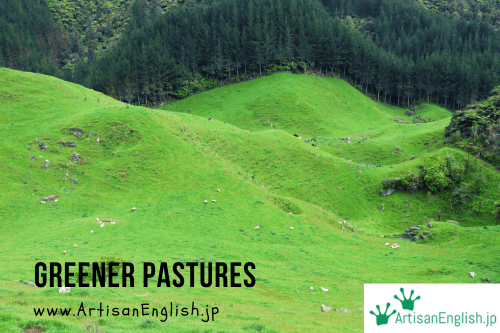
When people speak of greener pastures, they are thinking of a better or more promising situation than the current one they find themselves in.
People often use this expression when talking about leaving one job, place, or relationship in search of something better.
The Origin of Greener Pastures
The term comes from farming and husbandry.
No, not how to be a better husband, although that may make many wives happier.
Husbandry is the practice of farming crops and animals.
Animals always need fields with more green grass to eat.
Therefore, farmers move their animals to new fields or pastures with better grazing.
Funnily enough, this ties in with the saying, the grass is always greener on the other side, which means animals and people often think other situations are better than their own.
Not so funnily, both of these expressions relate to a third – put out to pasture, which means to retire someone or something.
Both expressions use the idea of green fields as symbols of rest, opportunity, or improvement.
Use Greener Pastures in Everyday Language
If you are thinking about changing jobs, you might say, “I’m leaving for greener pastures.”
This means you hope your new job will be better.
You can also use greener pastures when talking about moving to a new city, starting a new relationship, or making any change you believe will be better.
Remember, greener pastures does not always mean things will actually improve.
Sometimes, as the saying goes, the grass is always greener on the other side.
Greener Pastures and Life Decisions
When you are making a big decision, ask yourself whether you are looking for greener pastures or just bored.
Also, keep in mind the saying waste not, want not.
Sometimes, making the most of what you have is better than searching for greener pastures.
Flesch-Kincaid Readability Test
This post is understandable by someone with at least a 7th-grade education (age 12).
On the Flesch-Kincaid reading-ease test, this post scores 75.
The easier a passage is to read, the higher the score on a scale of 0 – 100.