YouTube / iTunes / Spotify / Radio Public / Pocket Casts / Google Podcasts / Breaker / Overcast
Listen to ArtisanEnglish.jp posts & lesson intros here.
WotD: Instant gratification
We live in an instant gratification world.
We all want what we want immediately.
Without considering the consequences of our impatience, we think, “Bigger, better, faster, more, give it to me now!”
With just a click, we can order food, watch movies, or buy products online.
This easy access makes waiting harder, and many people, especially younger generations, have become accustomed to getting what they want quickly.
Instant gratification has changed how we think about money and saving.
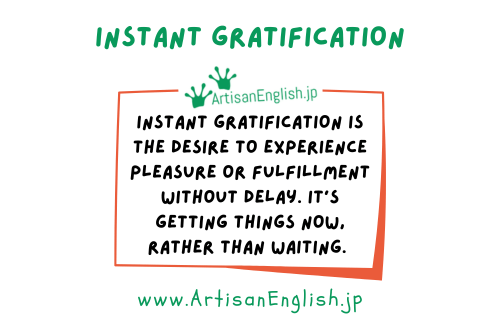
Instant gratification is the desire to experience pleasure or fulfillment without delay.
For example, when someone buys a new phone with a credit card rather than saving up, they are choosing instant gratification.
In today’s fast-paced world, instant gratification is ubiquitous.
In the past, people from the Silent Generation were more patient and careful with their spending.
They saved money for months or even years before making big purchases.
However, the instant gratification culture has made it difficult for many people today to save money for future needs.
Instead, they spend quickly and often without thinking about the long-term effects.
There is even a relatively new financial tool, referred to as Buy Now, Pay Later (BNPL), that perfectly exemplifies the normalization of this trend.
Instant gratification can also affect our patience.
When we get used to instant results, waiting becomes hard.
This is very different from the Silent Generation, who learned the value of patience and delayed rewards, believing good things come to those who wait.
Instant gratification can lead to problems like debt, as people want to enjoy things right away, even if they cannot afford them yet.
Instant gratification means wanting and getting things immediately, rather than waiting.
We have forgotten the benefits of patience and saving as the Silent Generation did.
Flesch-Kincaid Readability Test
This post is understandable by someone with at least a 7th-grade education (age 12).
On the Flesch-Kincaid reading-ease test, this post scores 75.
The easier a passage is to read, the higher the score on a scale of 0 – 100.