YouTube / iTunes / Spotify / Radio Public / Pocket Casts / Google Podcasts / Breaker / Overcast
Listen to ArtisanEnglish.jp posts & lesson intros here.
Phrase: Leave money on the table
There are some who believe that in negotiations, you should take all that you can get and never, ever leave money on the table.
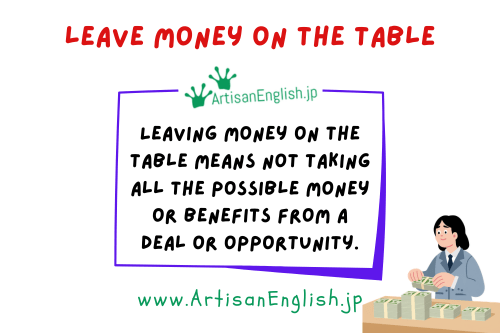
Leaving money on the table means not taking all the possible money or benefits from a deal or opportunity.
In simple terms, when you leave money on the table, you choose not to get the maximum financial gain, often on purpose.
Most times, people use this phrase to talk about missed opportunities, but in many situations, it can be a smart or ethical decision.
For example, imagine you are selling your car.
You get an offer that is fair, but not the highest you could get.
If you accept the offer, you leave money on the table.
In business, people sometimes leave money on the table to build trust, maintain long-term relationships, or act honestly.
There are moments in life when it is better to leave money on the table than to compromise your morals or beliefs.
For instance, if someone asks you to cheat or act unethically just to earn more, it is wise to leave money on the table.
Your values and reputation are often worth more than the extra cash you would have earned.
Another reason to leave money on the table is to show kindness or fairness.
If you are negotiating with someone who needs a break, you might leave money on the table to help them out.
This could be your good deed for the day, you know, pay it forward.
In summary, to leave money on the table means not taking every possible advantage.
Whether for honesty, kindness, or your own peace of mind, knowing when to leave money on the table can be a sign of true strength and character.
Flesch-Kincaid Readability Test
This post is understandable by someone with at least a 7th-grade education (age 14).
On the Flesch-Kincaid reading-ease test, this post scores 75.
The easier a passage is to read, the higher the score on a scale of 0 – 100.