YouTube / iTunes / Spotify / Radio Public / Pocket Casts / Breaker / Overcast
Listen to ArtisanEnglish.jp posts & lesson intros here.
Idiom: Living daylights
Definition of Living Daylights
Living daylights are a person’s senses or awareness.
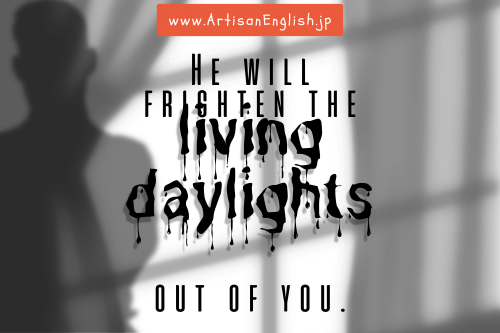
People often use this idiom when talking about feeling scared or shocked.
For example, if someone says, “It scared the living daylights out of me,” they mean they were really frightened.
Usage of Living Daylights
You’ll often hear living daylights in two main phrases: ‘scare the living daylights out of someone’ and ‘beat the living daylights out of someone.’
The first means to frighten someone a lot, such as when a loud noise in the dead night makes you jump.
The second means to hit or attack someone very badly, but people usually use it as an exaggeration, not to be taken literally unless you are dealing with a six-foot-three, 210-pound drunk and very angry man in a dark alley.
Just as an example.
Everyday Examples
You can use living daylights when you talk with friends.
For example, you might say, “The horror movie scared the living daylights out of me.”
Or, “He threatened to beat the living daylights out of his opponent if he cheated.”
Both phrases show strong feelings.
Why Use “Living Daylights”?
Using living daylights adds zest to your English by making it sound livelier and more expressive.
It shows strong feelings.
For example, “The sudden thunderstorm scared the living daylights out of the dog,” or, “The bully tried to beat the living daylights out of the smaller kids until he discovered one of them had a baseball bat.”
Just remember, living daylights isn’t a real thing.
It means your senses, feelings, or awareness.
Conclusion
Living daylights is a handy English idiom.
You can use it to talk about fear or violence powerfully.
So now if you meet a six-foot-three, 210-pound drunk and very angry man in a dark alley and he threatens to beat the living daylights out of you, at least you’ll die knowing what he meant.
Flesch-Kincaid Readability Test
This post is understandable by someone with at least a 7th-grade education (age 12 – 13).
On the Flesch-Kincaid reading-ease test, this post scores 63.
The easier a passage is to read, the higher the score on a scale of 0 – 100.