YouTube / iTunes / Spotify / Radio Public / Pocket Casts / Google Podcasts / Breaker / Overcast
Listen to ArtisanEnglish.jp posts & lesson intros here.
Word of the Day: Nimble
Estimated reading time: 3 minutes
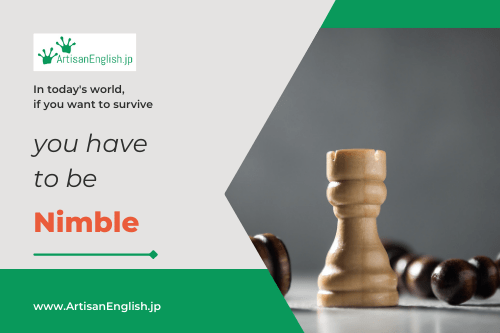
Being nimble is often the difference between life and death in the animal world.
Animals such as rabbits or deer are quite agile.
Their actions are very quick and exact.
If a hawk is chasing a rabbit, the rabbit’s ability to change direction quickly without falling may be its one skill to keep itself alive.
It’s not only animals that are nimble.
People and businesses can also be nimble.
Have you ever watched someone knitting, sewing or crocheting?
The people who do it well have very nimble fingers.
I recommend you try it.
During my teenage years, I actually enjoyed crocheting. Yes, I did!
I even crocheted while I was a construction worker.
After coming home after a long, hard day’s work, I found it quite relaxing.
It probably developed my fingers, which were a benefit when it came to woodworking.
This leads me to another understanding of the word nimble.
Rabbits can change direction quickly, people who crochet manipulate their fingers deftly, and businesses are nimble when they can quickly adapt to changing economic or market situations.
Like or follow ArtisanEnglish.jp on social media.
The COVID-19 pandemic has proven many companies to be resilient because they were able to be nimble.
Restaurants that are surviving quickly moved their menus online and switched to take-out and delivery instead of eat-in customers.
Japan, on the other hand, has proven that it is not nimble.
While New Zealand, Taiwan, and Singapore were incredibly nimble, shutting down international travel and requiring strict quarantines for returnees, Japan did not.
Nimbleness is why those countries’ citizens enjoy a ‘normal’ life, whereas the Japanese are enduring the fourth wave of infections.
The government is flopping around like a fish on a pier.
In a time of crisis, the nimble survive.
Flesch-Kincaid Readability Test
This post is understandable by someone with at least a 9th-grade education (age 15).
On the Flesch-Kincaid reading-ease test, this post scores 58.
The easier a passage is to read, the higher the score on a scale of 0 – 100.