YouTube / iTunes / Spotify / Radio Public / Pocket Casts / Google Podcasts / Breaker / Overcast
Listen to ArtisanEnglish.jp posts & lesson intros here.
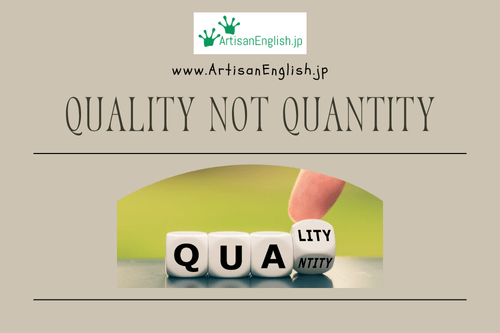
Saying: Quality not quantity
Quality, not quantity, is a popular saying that reminds us to focus on making things better, not just more.
When we say quality, not quantity, we mean that it is more important to do something well than to do it many times.
This idea can help us in our work, studies, and even our everyday lives.
Quality, not quantity, means that one good thing is better than many things that are average.
For example, if you write one excellent essay, it is better than writing ten essays that are not very good.
Using quality, not quantity, helps us remember that sometimes, less is more.
In school, teachers often say quality, not quantity, when they want students to focus on doing their best work, instead of just finishing many tasks quickly.
If you are learning a new skill, practicing with care and attention is another way to focus on quality, not quantity.
This method helps you improve more quickly than simply repeating the same thing over and over.
At work, quality, not quantity, can mean taking the time to do a task right, rather than rushing through it and making mistakes.
Many companies prefer employees who believe in quality, not quantity, because their work is more valuable.
Even in friendships, quality, not quantity, is important.
It is better to have a few close friends who truly care about you, rather than having many acquaintances who are not truly close.
I even created a lesson titled Friends: Quality or Quantity about this.
To sum up, quality, not quantity, teaches us to focus on doing things well.
Whether in school, work, or personal life, emphasizing quality, not quantity, can help us make better choices and achieve greater success.
Next time, try to choose quality, not quantity, in what you do!
Flesch-Kincaid Readability Test
This post is understandable by someone with at least an 8th-grade education (age 11 – 13).
On the Flesch-Kincaid reading-ease test, this post scores 65.
The easier a passage is to read, the higher the score on a scale of 0 – 100.