YouTube / iTunes / Spotify / Radio Public / Pocket Casts / Breaker / Overcast
Listen to ArtisanEnglish.jp posts & lesson intros here.
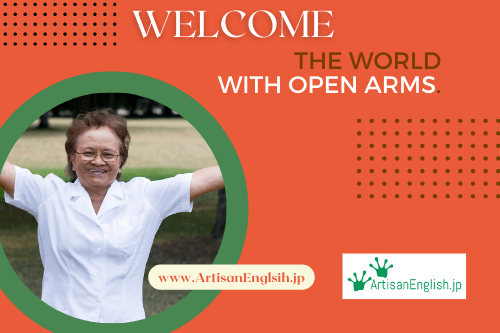
Phrase: With open arms
We have surprised ourselves and the rest of the world.
Once the word spread that Ukrainians were fleeing their country, Europeans welcomed them with open arms.
Poland has done much more than anyone could have expected.
Romania and even Japan have done what they can to accommodate those displaced by Russian aggression with open arms.
We accept someone with affection and enthusiasm when we welcome them with open arms.
In normal times Canada gained a reputation for accepting well over a hundred thousand refugees every year and welcoming them with open arms.
It’s just what we do.
Now, you may think that everyone is welcoming refugees and displaced persons out of the goodness of their hearts, and you’d be right.
There are, however, other reasons.
When people move to a country, they initially require much assistance.
Over time as they adjust to their new surroundings, they thrive and contribute much more to their new country than they ever received.
Therefore, it’s beneficial to both the welcomed and the welcomers.
It’s highly unusual for Japan to accept hundreds of refugees or displaced persons from anywhere, let alone a war-torn European country.
By welcoming Ukrainian women and children with open arms, Japan builds cultural, emotional, social, and historical ties that will last more than a lifetime.
Perhaps one day, a Japanese traveller who finds themselves in dire straits in Ukraine will be welcomed with open arms into someone’s home and provided food, shelter, and a helping hand.
We would expect European countries to do all they could to help Ukrainians.
This is why I believe it is so crucial for Japan to reach out now.
Ukrainian men fighting for their country can fight harder if they know their loved ones are safe in Japan after being welcomed with open arms.
Flesch-Kincaid Readability Test
This post is understandable by someone with at least an 8th-grade education (age 13 – 14).
On the Flesch-Kincaid reading-ease test, this post scores 61.
The easier a passage is to read, the higher the score on a scale of 0 – 100.